
Preparing Your Site for AEO: The First 7 Actions to Take
Search is changing. Answer Engine Optimisation is no longer a niche concern. Here is what to do about it, and a Claude Code skill that can automate most of the audit for you.
INTRODUCTION
Search is changing fast. Answer Engine Optimisation (AEO) is no longer a niche concern. It matters to any marketer who wants their content to be found, read, and cited by AI systems. Whether that is ChatGPT, Google AI Overviews, Perplexity, Claude, or the next tool your audience uses tomorrow. The good news: most of what AEO requires is good search marketing practice anyway. If you have been putting off a site review, this is the moment to start.
WHAT IT MEANS
Understand What AEO Actually Is
AEO stands for Answer Engine Optimisation. Where traditional SEO focuses on ranking in search results, AEO focuses on being selected as the answer. The snippet. The citation. The source an AI system pulls when someone asks a question.
AI systems do not browse. They synthesise. They pull from content they consider authoritative, clearly structured, and directly useful. If your site is not written with that in mind, you can rank well in conventional search and still be invisible in AI-generated responses.
People are no longer only Googling. They are asking ChatGPT, Perplexity, and Claude for recommendations. Traditional SEO agencies are mostly still optimising for ten blue links. The two strategies are not mutually exclusive, but you need both, and most sites are not yet set up for the second one.
ACTION 1
Audit Your Core Questions
Start by listing the ten questions your audience asks most often. Do not guess. Look at your search data, your social comments, your customer service enquiries. What do people actually want to know?
For a venue or live experience: "best immersive experiences in London", "things to do in Manchester this weekend", "fun date night ideas". For each question, check whether your site provides a direct, clear answer. Not buried in a long paragraph. Not hidden behind a wall of context.
THE TEST: Paste your question into ChatGPT or Perplexity. Does your site appear in the answer? If not, start there. That gap is the audit.
ACTION 2
Write in Question-and-Answer Format
AI systems are trained to find answers to questions. If your content is written in flowing prose without clear signposting, it is harder for those systems to identify the relevant section and cite it.
Restructure key pages to include explicit questions as subheadings and answer them directly in the paragraph that follows. This works for readers and for AI alike.
Two rules worth following immediately. Do not hide FAQs behind dropdown boxes. AI crawlers cannot read these. And: if someone asked your subheading as a question in a search bar, would your next paragraph give them a satisfying answer? If not, rewrite it until it does.
QUICK WIN: Take your three most visited pages. Rewrite the first subheading on each as a question your audience actually asks. Then check whether the paragraph that follows answers it within the first two sentences.
ACTION 3
Add Structured Data Where It Matters
Schema markup is code embedded in your site that helps search engines and AI systems understand what your content is about. It is invisible to readers but it matters to the machines reading your pages.
Article schema, Organisation schema, and Event schema are good starting points for experience economy sites. FAQ schema is currently restricted by Google to government and health sites, so skip that one. If you are on WordPress, plugins handle most of this without a developer.
One thing worth doing today: generate a llms.txt file for your site. This is an emerging standard, similar to robots.txt, that helps AI crawlers understand your site structure. There is a free generator at llmstxt.org. It takes about ten minutes and signals to AI systems that your site is structured and intentional.
ACTION 4
Improve Your Page Structure
AI systems parse content hierarchically. H1, H2, H3 headings are not just for designers. They signal the structure and priority of your information. If your pages use headings inconsistently, or rely on visual formatting rather than semantic HTML, that is worth reviewing.
Each page needs one clear H1. Subheadings should create a logical hierarchy. Every section should have a clear purpose. A clean structure is good for accessibility, good for traditional SEO, and increasingly important for AI readability. These three things overlap almost entirely.
ACTION 5
Write More Concisely
Vague content does not get cited. Padded introductions, hedged conclusions, and over-qualified statements make it harder for AI systems to extract a clear answer. They will move on to a source that is more direct.
This does not mean dumbing down your content. It means being precise. Give the answer before explaining the context, not after. Use short paragraphs. Earn the reader's attention with the first sentence.
ACTION 6
Check Your AI Crawler Access
AI systems use their own crawlers to index content. GPTBot (OpenAI), ClaudeBot (Anthropic), PerplexityBot, and at least eleven others. If your robots.txt file is blocking these crawlers, you are invisible to AI-generated search responses regardless of how well your content is structured.
Go to yoursite.com/robots.txt and check. If you see blanket disallow rules, ask your developer to allow the major AI crawlers explicitly. This is a five-minute fix with material consequences for AI visibility.
CHECK YOUR ROBOTS.TXT, OR USE THIS CLAUDE PROMPT
Go to [yoursite.com]/robots.txt and tell me which AI crawlers are currently blocked. Check specifically: GPTBot, ClaudeBot, PerplexityBot, Applebot-Extended, and Amazonbot. If any are blocked, tell me what to add to allow them.
ACTION 7
Build Authority Through Consistent Publishing
AEO rewards sites that are recognised as authorities on a topic. That recognition comes from consistency. Regular, relevant, well-written content that demonstrates expertise over time.
You do not need to publish daily. Two to four posts a month maintained consistently will outperform a burst of twenty posts followed by silence. The algorithm and the audience both respond to reliability.
Brand mentions on high-authority platforms correlate more strongly with AI visibility than traditional backlinks. YouTube, Reddit, LinkedIn, and relevant niche forums. If your brand is not present on platforms AI systems reference, building that presence is a higher priority than most technical fixes.
HOW TO AUTOMATE MOST OF THIS AUDIT
All seven of the actions above require judgment. Some of them also require time to investigate what is actually wrong before you can fix it. There is a free Claude Code skill that handles the investigation part at speed.
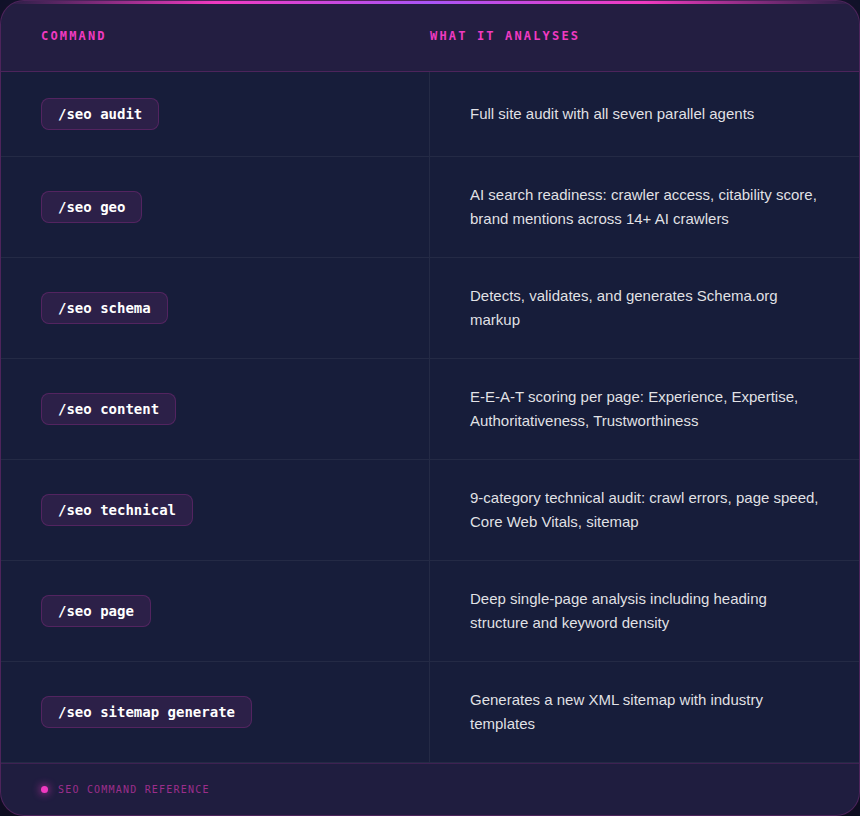
It is called claude-seo, built by AgriciDaniel, and it is free on GitHub. It spins up seven parallel AI agents that crawl your site simultaneously, each specialising in a different aspect of the audit. The whole thing runs in about three minutes.
INSTALLATION
Mac / Linux:
curl -fsSL https://raw.githubusercontent.com/AgriciDaniel/claude-seo/main/install.sh | bash
Windows (PowerShell):
git clone --depth 1 https://github.com/AgriciDaniel/claude-seo.git
powershell -ExecutionPolicy Bypass -File claude-seo\install.ps1
Or via Claude Code desktop app, tell it:
Install the SEO skill from https://github.com/AgriciDaniel/claude-seo
Once installed, run the full audit with one command:
/seo audit https://yoursite.com
The seven audit commands:
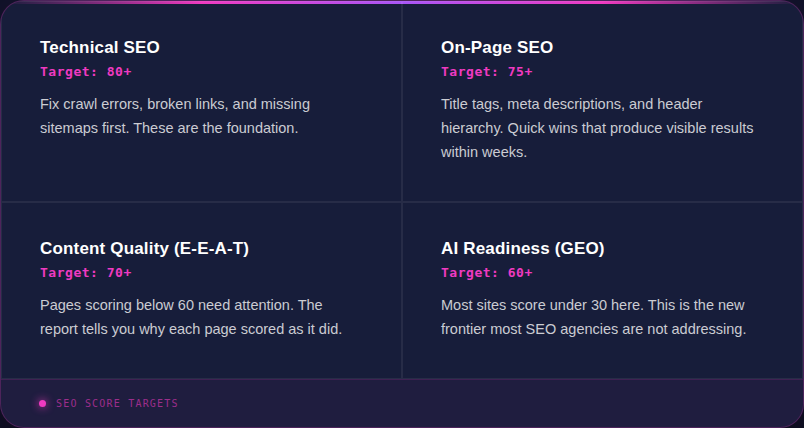
Health score targets:
Once you have the audit results, feed them back to Claude Code:
Based on the SEO audit you just ran, implement the top 10 highest-priority fixes. Start with technical SEO issues, then on-page optimisation, then content gaps. Show me what you changed and why.
ON COST: A traditional SEO agency costs £1,500 to £8,000 per month and rarely includes any AI search strategy. Claude Code costs £17 per month, runs the audit in 3 minutes, and the GEO module is built in. Do the foundational work yourself. Invest the savings in content and genuine authority building.
4-WEEK PLAN
A Practical Starting Point
WEEK 1. FOUNDATION. Install Claude Code and the SEO skill. Run the full audit on your site. Fix all critical technical issues: broken links, missing sitemaps, crawl errors. Allow AI crawlers in your robots.txt.
WEEK 2. ON-PAGE QUICK WINS. Optimise title tags and meta descriptions for your top 20 pages. Fix header hierarchy issues. Add schema markup. Generate and add a llms.txt file.
WEEK 3. CONTENT UPGRADES. Write content for your top three keyword gaps identified in the audit. Update your five lowest-scoring E-E-A-T pages. Build internal links between related content. Add author bios and credentials where they are missing.
WEEK 4. AI SEARCH VISIBILTY. Search for your brand in ChatGPT, Perplexity, and Google AI Overviews. Build presence on two or three platforms AI systems reference: YouTube, Reddit, LinkedIn. Re-run the full audit and compare the scores. Set a monthly calendar reminder to re-audit.
FOUNDATION FIRST
What Comes Next
These seven actions and this one tool are the foundation. Once they are in place, you can move into more advanced territory: internal linking strategies, topical authority mapping, voice search optimisation, and monitoring how your content is being cited across AI platforms.
The sites being cited by AI systems in 2025 and 2026 are not necessarily the most prominent. They are the ones with clear structure, direct answers, and consistent publishing histories. That is entirely achievable.
Get these right, and the rest becomes significantly easier.
Want to talk this through?
The On Sale Live: The Experience Economy Expo is a good place for practical conversations about search, visibility, and marketing in the experience economy. No hype. Sector-specific.
Written and published by Dawn Farrow’
ON SALE LIVE: THE EXPERIENCE ECONOMY EXPO | onsale.live